Overview of Bacterial Metabolism
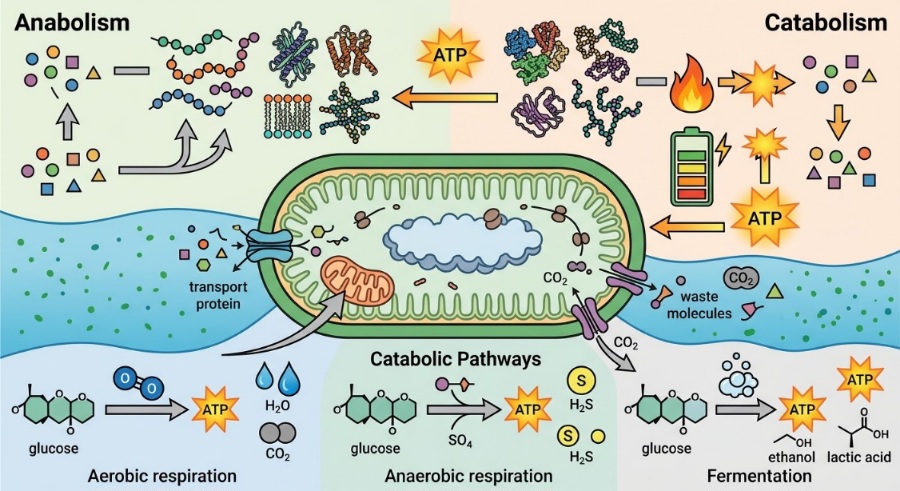
Bacterial metabolism is the engine driving the survival, growth, and reproduction of prokaryotes. Because bacteria lack membrane-bound organelles like mitochondria or chloroplasts, all metabolic machinery operates across the plasma membrane and within the cytoplasm. Their immense metabolic diversity allows them to thrive in environments ranging from deep-sea hydrothermal vents to the human gut.
Carbon Sources: Building Blocks of the Cell
Carbon forms the structural backbone of every organic molecule inside a cell, including proteins, DNA, RNA, lipids, and carbohydrates. Bacteria fall into two fundamental categories based on how they harvest carbon:
Autotrophs (Self-feeders):
Autotrophic bacteria take inorganic carbon dioxide (CO2) from their environment and assemble it into complex organic molecules through a process called carbon fixation. The most common pathway for this is the Calvin-Benson-Bassham cycle, where the enzyme RuBisCO incorporates CO2 into organic precursors. Because fixing CO2 requires a massive input of energy and reducing power (ATP and NADPH), autotrophs act as primary producers in ecosystems, creating organic matter from scratch.
Heterotrophs (Other-feeders): Heterotrophic bacteria cannot utilize CO2 as their main carbon source. Instead, they absorb ready-made organic compounds—such as simple sugars (glucose), amino acids, fatty acids, or organic acids—secreted or left behind by other organisms. Once imported into the cell, these organic molecules are either broken down to yield energy or reorganized via central metabolic pathways (like glycolysis and the TCA cycle) to build cellular structures. Most known bacteria, including human pathogens, are heterotrophs.
Energy Sources: Powering Cellular Work
To drive cellular processes—such as active transport, flagellar motility, and biosynthesis—bacteria must generate adenosine triphosphate (ATP). They capture this energy using one of two external sources:
Phototrophs: These bacteria harness light energy (photons). Sunlight hits specialized photosynthetic pigments, such as bacteriochlorophylls or chlorophylls, embedded in specialized invaginations of the cell membrane. The absorbed light excites electrons within these pigments, driving them through an electron transport system to generate a proton gradient. This gradient then powers ATP Synthase to produce ATP via photophosphorylation.
Chemotrophs: Chemotrophic bacteria do not use light; instead, they capture energy stored within chemical bonds. By transferring electrons from high-energy chemical donors to lower-energy acceptors through oxidation-reduction (redox) reactions, they release energy. This energy is harvested either by generating a proton motive force across the membrane or via substrate-level phosphorylation during enzymatic steps.
Electron Sources: Fueling Biosynthesis and Energy Chains
Metabolism relies heavily on electron transfers (redox reactions). Bacteria require a constant supply of electrons (reducing power, typically carried as NADH or NADPH) to fix carbon, build complex polymers, and keep the electron transport chain running.
Lithotrophs (Inorganic-eaters): Unique to the microbial world, lithotrophic bacteria remove electrons from reduced inorganic molecules. Common electron donors include hydrogen sulfide (H2S) ,elemental sulfur (S0),ammonia (NH3), nitrite (NO-2), ferrous iron (Fe2+), and hydrogen gas (H2). Lithotrophs play vital roles in global biogeochemical cycles, such as the nitrogen and sulfur cycles, by transforming raw minerals into oxidized forms.
Organotrophs: Organotrophic bacteria strip electrons from organic compounds, such as glucose, lactate, or amino acids. As enzymes break the covalent bonds within these organic substrates, paired electrons and protons (hydrogen atoms) are transferred to coenzymes like NAD+ and FAD, forming NADH and FADH2. These reduced coenzymes then deliver their high-energy electrons directly to energy-yielding pathways.
Energy Production: Harvesting ATP and Maintaining Redox Balance
To continuously produce ATP, bacteria must break down substrates and recycle their electron carriers (oxidizing NADH back into NAD+). They use three primary metabolic strategies to achieve this:
Aerobic Respiration: This is the most energetically efficient pathway available to bacteria.
Fuel molecules (like glucose) are broken down through glycolysis and the Krebs cycle, generating ATP, NADH, and FADH2.
These coenzymes pass their electrons to an Electron Transport Chain (ETC)—a series of membrane-bound protein complexes.
As electrons travel down the chain, protons (H+) are pumped out of the cytoplasm across the plasma membrane, creating an electrochemical gradient known as the proton motive force (PMF).
Molecular oxygen (O2) acts as the final terminal electron acceptor at the end of the chain, combining with protons to form water (H2O).
Protons flow back into the cell through ATP Synthase, generating large amounts of ATP via oxidative phosphorylation (~32–38 ATP per glucose molecule).
Anaerobic Respiration: This pathway operates similarly to aerobic respiration using a membrane-bound Electron Transport Chain and generating a proton motive force. However, it functions entirely in the absence of O2.
Instead of oxygen, anaerobic respirers use alternative inorganic molecules as their terminal electron acceptors, such as nitrate (NO3-), sulfate (SO2-4), or carbon dioxide (CO2). Because these alternative acceptors have a lower reduction potential than oxygen, the overall energy yield is slightly less than in aerobic respiration, but still significantly higher than fermentation.
Fermentation: Fermentation is an anaerobic process used when a functional Electron Transport Chain or suitable external electron acceptor is unavailable.
It relies exclusively on glycolysis to produce a small amount of net energy (2ATP} per glucose) via substrate-level phosphorylation (direct transfer of a phosphate group to ADP by an intermediate enzyme).
Because there is no ETC to take electrons from NADH, the cell faces a crisis: NAD+ reserves will run out, shutting down glycolysis entirely.
To solve this, the cell transfers the electrons from NADH directly back onto pyruvate (or a pyruvate derivative), restoring NAD+.
This reduction of pyruvate creates organic metabolic end-products—such as lactic acid, ethanol, acetate, or isopropanol—which are excreted from the cell as waste.
From a practical, bench-scale laboratory and field research perspective—particularly when working in environmental microbiology, water quality assessment, wastewater treatment, bioaerosols, and environmental health hazard analysis—bacterial metabolism is the fundamental biological engine that drives everything observed, measured, and cultured.
Understanding bacterial metabolic pathways is essential across primary research areas for the following practical reasons:
1. Selective Media Design and Wet-Lab Identification
In environmental hygiene and microbiology laboratories, isolation of specific target bacterial groups (e.g., coliforms, Bacillus species, Staphylococcus, or Pseudomonas) relies directly on tailoring culture media to their metabolic capabilities.
Exploiting Carbon & Sugar Fermentation: Differential media like MacConkey Agar or Eosin Methylene Blue (EMB) rely on whether an organism is an organotroph capable of fermenting lactose. The production of organic acid metabolic byproducts lowers pH, triggering visual color changes via pH indicators (such as neutral red or phenol red).
Enzymatic Activity & Phenotypic Profiling: Biochemical confirmation tests used in the laboratory—such as catalase, oxidase, nitrate reduction, indole production, and citrate utilization—are direct assays of metabolic machinery. Testing for citrate utilization, for example, evaluates whether an organism possesses the specific transport proteins and enzymes needed to use citrate as its sole carbon source.
2. Bioremediation and Chemical Contaminant Transformation
Understanding how microbes process inorganic and organic substances is essential for evaluating environmental pollution mitigation in water, soil, and wastewater systems.
Heavy Metal and Trace Element Dynamics: Bacterial interactions with metals like iron (Fe), chromium (Cr), or arsenic (As) are heavily driven by redox metabolism. Many lithotrophic or respiratory bacteria alter metal oxidation states—either using reduced metal species as electron donors or using oxidized metals as terminal electron acceptors during anaerobic respiration. At the bench scale, this metabolic activity directly impacts whether heavy metals precipitate out of solution or become solubilized and bioavailable.
Degradation of Complex Organic Waste: Wastewater treatment processes rely on microbial communities using aerobic respiration, anaerobic respiration, and fermentation to break down carbonaceous organic waste (measured via Biochemical Oxygen Demand, BOD). Understanding whether bacteria act as organotrophs converting organic carbon into CO2, or anaerobes generating fermented organic acids, dictates the efficiency of biological treatment processes.
3. Bioaerosol Viability, Sampling, and Stress Physiology
When monitoring airborne bacteria (bioaerosols) emitted from treatment facilities or urban environments using cascade impactors, liquid impingers, or impaction onto agar plates, bacterial metabolism dictates survival and culturability.
Metabolic Recovery Post-Sampling: Environmental stress—such as desiccation, solar radiation, and shear forces experienced during aerosolization—causes metabolic stress or pushes bacteria into a Viable But Non-Culturable (VBNC) state. Resuscitating these cells in liquid media (like Tryptic Soy Broth) requires providing specific electron donors and carbon sources that match their metabolic machinery to allow repair of cellular membranes and restore active respiration.
Differentiating Aerobic vs. Anaerobic Airborne Microflora: The physical location of sampling (e.g., aeration tanks versus anaerobic digesters) shifts the dominant bacterial metabolism. Oxygen exposure during bioaerosol collection will select for obligate aerobes and facultative anaerobes while killing strict anaerobes unless specialized anaerobic collection conditions are used.
4. Antimicrobial Resistance (AMR) and Physiological State
When measuring antibiotic susceptibility or resistance mechanisms in environmental samples, metabolic rate plays a critical role in wet-lab execution and interpretation.
Phenotypic Expression of Resistance: Standardized laboratory assays, such as disk diffusion or minimum inhibitory concentration (MIC) determinations, require active microbial growth and protein synthesis. The metabolic activity of the strain directly dictates the growth rate, inoculum density, and the rate at which resistance enzymes (like \beta-lactamases or efflux pumps) are synthesized.
Metabolic Inactivation of Antibiotics: Bacteria frequently alter or degrade antibiotics through metabolic pathways. Understanding whether a strain metabolizes a drug or pumps it out via energy-dependent active transport (requiring ATP generated through respiration) is key to evaluating environmental reservoirs of resistance.
5. Biogeochemical Cycling in Aquatic and Environmental Systems
In surface water, groundwater, or wastewater ecosystems, microbial metabolic classes directly govern nutrient cycles.
Nitrogen Transformation: The conversion of ammonia (NH3) to nitrite (NO-2) and nitrate (NO-3) is driven by lithotrophic nitrifying bacteria using inorganic nitrogen as an electron donor. Conversely, anaerobic respirers (denitrifiers) use nitrate as a terminal electron acceptor to reduce it back to nitrogen gas (N2). Laboratory quantification of these nitrogen species serves as a direct indicator of which bacterial metabolic groups are dominating the ecosystem.
Sulfur and Oxygen Dynamics: In low-oxygen zones of water or sludge, lithotrophs and anaerobic respirers use sulfur compounds (H2S, SO2-4), impacting water pH, odor generation, and chemical oxygen demand.