Monod Growth Kinetics
Overview
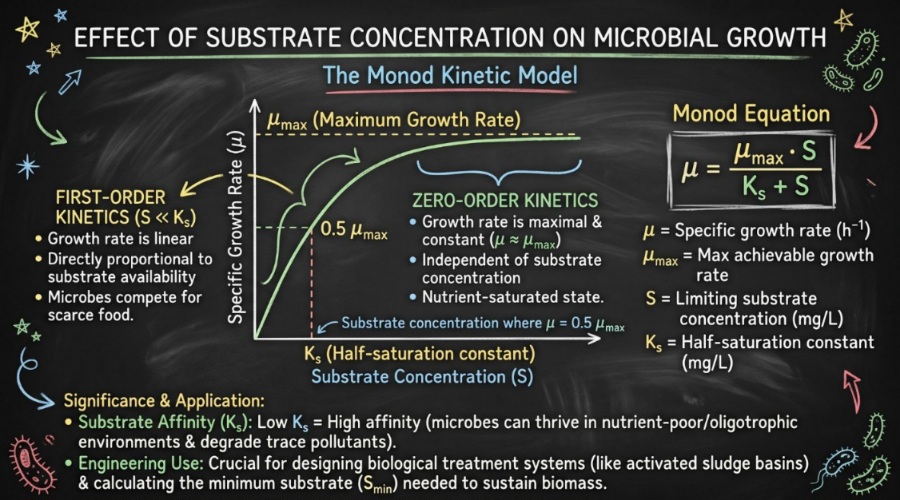
The Monod equation describes the relationship between the specific growth rate of a bacterial population ($\mu$) and the concentration of a limiting substrate (S).
The Monod Equation:
$\mu = \frac{\mu_{\max} \cdot S}{K_s + S}$
Key Variables & Parameters:
$\mu$ (Specific Growth Rate): The actual growth rate of the bacteria per unit of time (measured in $h^{-1}$).
$\mu_{\max}$(Maximum Specific Growth Rate): The highest possible growth rate achievable under non-limiting, optimal conditions.
S (Substrate Concentration): The concentration of the limiting nutrient or food source available to the microorganisms (measured in mg/L).
$K_s$ (Half-Saturation Constant):The substrate concentration at which the growth rate reaches half of its maximum value ($\mu$ = $0.5 \cdot \mu_{\max}$). Measured in mg/L.
How Substrate Concentration Affects Growth Rate
A. High Substrate Concentration ($S \gg K_s$)
Behavior: Zero-Order Kinetics
Explanation: When nutrients are abundant, the enzymes/bacteria are fully saturated.
Outcome: The growth rate reaches its maximum ($\mu \approx \mu_{\max}$) and becomes independent of the substrate concentration. Adding more food will not speed up growth.
B. Low Substrate Concentration ($S \ll K_s$)
Behavior: First-Order Kinetics
Explanation: When nutrients are scarce, growth is directly proportional to the amount of food available.
Outcome: The growth rate becomes linear with respect to substrate availability. Any increase in food directly increases the growth rate.
Importance of the Parameter $K_s$(Substrate Affinity)
The parameter $K_s$ reflects a microorganism’s affinity (preference/ability to grab) for a specific substrate:
Low $K_s$ value: Indicates high affinity.
The microbes can grow effectively even in nutrient-poor (oligotrophic) environments or degrade trace amounts of chemical pollutants.
High $K_s$ value: Indicates low affinity.
Microbes require higher nutrient levels to achieve high growth rates.
Practical Applications in Environmental Health & Engineering

Understanding and estimating Monod kinetic parameters allows environmental engineers and researchers to:
Design Biological Treatment Systems: Optimize biological wastewater treatment processes such as activated sludge basins.
Predict Contaminant Degradation: Forecast how fast pollutants will be broken down in natural or engineered environments.
Determine Minimum Substrate Concentration ($S_{\min}$): Calculate the minimum amount of substrate required to sustain a stable microbial biomass.
Evaluate Bioremediation Feasibility: Determine whether biological cleanup methods are realistic and effective for hazardous contaminants.